

Best overall for Indian media submission: India PR Distribution. Best for journalist-selected stories: specialist media outreach. Best for hands-on control: self-service submission. This 2026 guide to the best press release distribution services for ecommerce brands compares five service approaches by campaign purpose, deliverables, and publication control, not by promises of guaranteed coverage.
- India PR Distribution suits ecommerce brands needing press release writing and submission to Indian media.
- The best press release distribution services for ecommerce brands separate distribution, paid placement, and editorial outreach.
- Choose specialist media outreach for journalist-selected coverage; buying distribution does not buy editorial approval.
- Match your ecommerce PR brief to the audience, publication format and evidence behind your announcement.
Why this matters
An ecommerce launch needs the right service, not simply the longest outlet list. Sending a release, purchasing a defined placement, and persuading a journalist to report a story are different transactions. Each needs a different brief and a different measure of completion. India PR Distribution is best for ecommerce brands seeking press release writing and submission to Indian media. Its stated service covers Indian newspapers, TV channels, magazines, and online news outlets. Independent editorial coverage remains a decision for the receiving publication. For your 2026 campaign, establish the intended result before comparing proposals. A documented submission campaign is not interchangeable with a sponsored article, an interview, or a reported product story.
What makes the best ecommerce press release service?
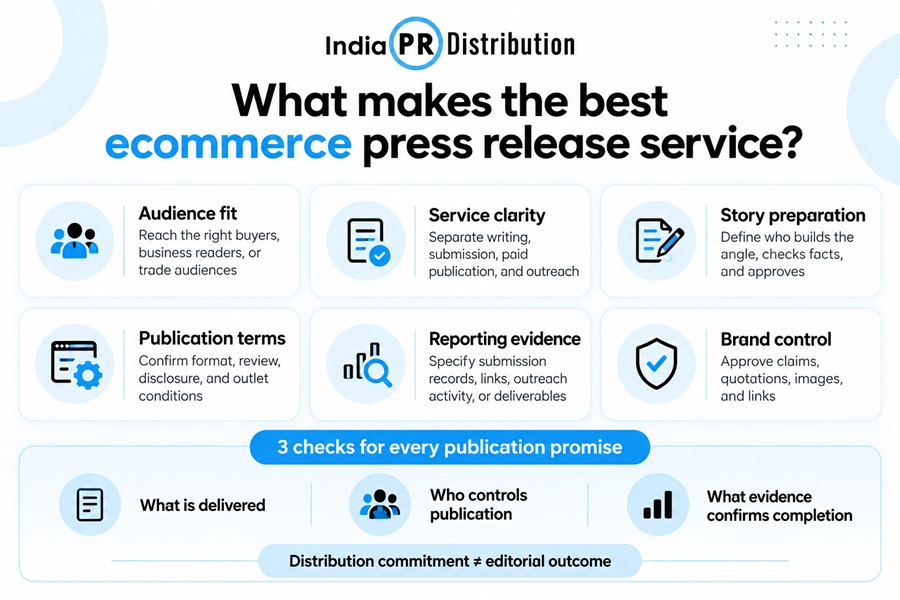
Use these criteria to assess the service before assessing the sales presentation:
- Audience fit: Identify the buyers, business readers, or trade audiences your announcement needs to reach. National visibility and category relevance are separate goals.
- Service clarity: Require a clear distinction between writing, submission, paid publication, and journalist outreach. Do not accept one vague promise of coverage for all four.
- Story preparation: Establish who develops the angle, checks factual claims, and obtains approval before distribution.
- Publication terms: Confirm the format, editorial review, disclosure requirements and conditions attached to any named outlet.
- Reporting evidence: Ask what documents are required for completion: submission records, published links, outreach activity, or another agreed deliverable.
- Brand control: Specify who approves product claims, quotations, images and links. Keep your release consistent with the customer-facing announcement.
Apply 3 checks to every publication promise: what is delivered, who controls publication, and what evidence confirms completion. These checks expose the difference between a distribution commitment and an editorial outcome.
Ecommerce PR services at a glance
The first entry is a named provider. The remaining entries are service approaches you can request from a supplier or manage internally; they are not invented agency names.
| Ranked option | Best for | Standout capability |
|---|---|---|
| India PR Distribution | Indian media submission with writing support | Press release writing and submission across Indian media formats |
| Distribution-only service | Teams with an approved release | A focused brief centred on sending the release |
| Paid placement service | A defined publication deliverable | Written terms for a specified paid publication format |
| Specialist media outreach | A story requiring journalist consideration | Individual pitches built around editorial relevance |
| Self-service submission | Teams managing release delivery internally | Direct control over preparation and submission |
1. India PR Distribution: best for Indian media submission

India PR Distribution provides press release writing and distribution services. It submits client releases to Indian newspapers, TV channels, magazines, and online news outlets, serving businesses, startups, and PR professionals seeking Indian media coverage. For an e-commerce brand, this service scope fits a campaign that needs both release preparation and submission to Indian media. State whether your announcement concerns a product launch, business development, or another verified company milestone. Then define the audience and the facts supporting the story.
India PR Distribution pros:
- Writing and distribution are both within the stated service scope.
- Indian media is the explicit geographic focus.
- Submission covers several media formats, not only online outlets.
Best for: Ecommerce founders and marketing teams seeking Indian press release writing and media submission.
Verdict: Buy for a defined Indian writing-and-submission brief; do not treat submission as an editorial guarantee.
2. Distribution-only service: best for an approved release
A distribution-only service focuses on sending a release that your team has already prepared. Choose this scope when the announcement, factual checks, and approvals are complete, and you need execution rather than story development. The practical distinction is ownership. Your team remains responsible for the release’s accuracy and relevance; the supplier’s deliverables should identify the submission activity it will perform. Add writing, editing, or outreach explicitly if you need them. Distribution-only service pros:
- Keeps the purchasing brief focused on release delivery.
- Leaves your team in control of the final wording.
- Makes submission responsibilities easier to define.
Distribution-only service cons:
- Does not address an unfinished or poorly supported announcement.
- Individual journalist pitching requires an explicit addition.
- Submission evidence does not prove audience attention.
Best for: Ecommerce marketing teams with a fully approved announcement and internal writing support.
Verdict: Buy when the release is ready; hold when the angle or evidence still needs work.
3. Paid placement service: best for a defined publication format
A paid placement service concerns publication under commercial terms. The deliverable needs to specify the outlet, article format, review conditions, and any required disclosure before you commit. This route suits a brief where the publication format itself matters. It does not replace independent reporting, and you should not describe a paid article as a journalist’s endorsement. Any placement guarantee must come from the specific package’s verified written terms. Paid placement service pros:
- Lets you evaluate a specific publication deliverable.
- Makes format and disclosure requirements central to the agreement.
- Gives your approval team a defined commercial scope to review.
Paid placement service cons:
- Is distinct from independently selected editorial coverage.
- Remains subject to the publication’s applicable review conditions.
- Does not establish sales impact or customer trust by itself.
Best for: Brands seeking a clearly specified paid publication format, rather than an earned-media claim.
Verdict: Buy only against verified placement terms; skip proposals that present payment as editorial endorsement.
4. Specialist media outreach: best for journalist-selected coverage
Specialist media outreach presents a story to relevant journalists for editorial consideration. The work centres on the pitch, supporting evidence, spokesperson access, and follow-up, not merely sending the same release to a list. Use this approach when your ecommerce announcement has a defensible news angle. A journalist needs a reason to cover the development for their audience, not simply a request to publish your product description. Prepare to answer questions and supply evidence beyond the release. Specialist media outreach pros:
- Centres the campaign on editorial relevance.
- Supports individual pitches and journalist questions.
- Separates outreach activity from publication decisions.
Specialist media outreach cons:
- Cannot promise independent editorial acceptance.
- Requires spokesperson availability and supporting material.
- Gives your brand less control over the eventual reporting.
Best for: Ecommerce businesses with a substantiated story and a spokesperson ready for editorial scrutiny. Verdict: Buy for a credible news angle; wait if your brief is only a sales message.
5. Self-service submission: best for internal campaign control
Self-service submission means your team prepares the release, researches submission requirements, and sends the material directly. It is a workflow rather than an outsourced agency package. Choose it when internal ownership matters and your team can handle the work. Record each destination and its requirements before sending. A submission form confirms a route for sending material, not a promise that the outlet will publish it. Self-service submission pros:
- Keeps release preparation and destination choices in-house.
- Gives your team direct knowledge of submission requirements.
- Lets you maintain your own campaign records.
Self-service submission cons:
- Assigns research and administration to your team.
- Requires internal writing and factual review.
- Does not create access to a journalist’s editorial calendar.
Best for: Teams with writing capacity and a clear owner for media submissions.
Verdict: Buy into this workflow only with an accountable internal owner; skip it as an unassigned side task.
How the ranking works
This 2026 ranking prioritises service fit: Indian media submission, release readiness, publication format, editorial ambition and internal capacity. It does not rank suppliers by unverified reach figures or imply that these different services produce equivalent results. The default recommendation follows the stated brief. If you need Indian writing and submission, select that scope. If you need independent journalism, procure outreach and accept that the publication controls the outcome.
Turn your announcement into a qualified campaign brief
Use 1 campaign brief to align your marketing team, approver, and supplier. Keep the purchasing decision tied to a specific announcement rather than a general request for brand visibility.
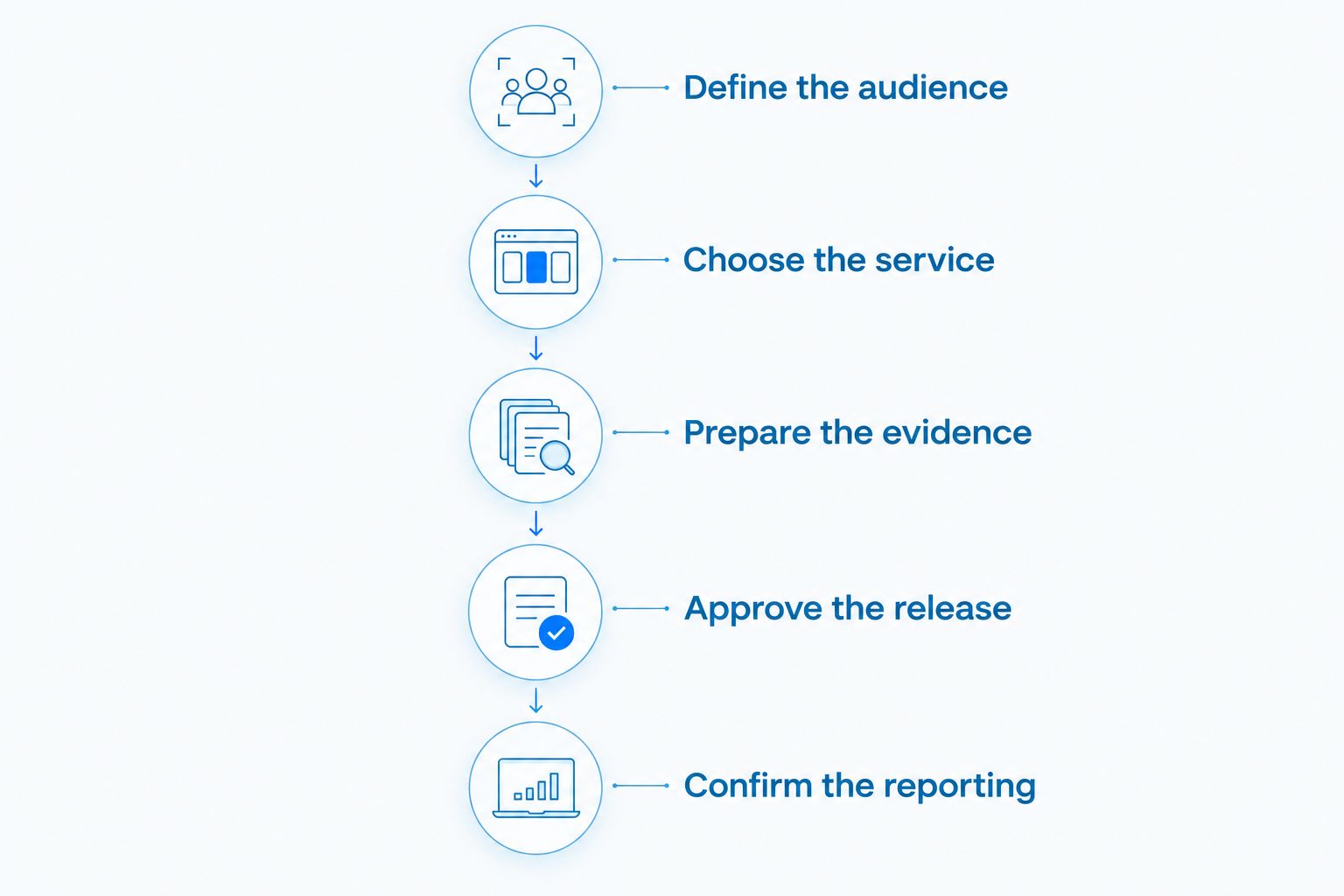
1. Define the audience
Identify who should understand the announcement and why it matters to them. An e-commerce product story aimed at consumers needs a different angle from a business announcement aimed at investors, partners, or trade readers.
2. Choose the service
State whether you need writing and submission, distribution alone, paid placement, or editorial outreach. If you need more than one, separate the deliverables rather than treating them as a single coverage promise.
3. Prepare the evidence
Supply the facts supporting the announcement, approved product details, and any quotations authorised for use. Exclude unsupported claims such as category leadership or exceptional performance. Promotional language does not replace evidence.
4. Approve the release
Use 2 approval stages: factual approval, then publication approval. First confirm the accuracy of claims and quotations; then confirm the final wording, assets, and distribution instructions.
5. Confirm the reporting
Define what your team will receive after execution. Match the report to the purchased service: submission records for distribution, agreed publication evidence for placement, and documented pitching activity for outreach.
For a 2026 campaign, put the complete brief beside each supplier proposal. Remove deliverables that do not serve your objective, and ask for clarification wherever a publication outcome is described without its conditions.
Discuss your Indian PR campaign
Describe your announcement, audience, and required writing or distribution scope.
Check named-publication claims before committing
If your brief names Times of India, Economic Times, Hindustan Times, ANI, PTI, Mid Day, Forbes or Business Today, ask what the supplier means by inclusion. A publication name in a presentation is not enough to define the transaction. For each named outlet, request the exact publication or edition, intended format, approval conditions, and evidence of the agreed deliverable. Separate an editorial pitch from a submission destination and a paid placement. Do not assume a proposal offers all three. Keep these distinctions visible in your 2026 approval document. Your team should be able to describe the purchased service accurately without converting a commercial placement into a claim of independent endorsement.
Which service should your ecommerce brand choose?
Choose India PR Distribution for a brief centred on press release writing and submission to Indian media. Choose distribution alone when your release is approved; choose paid placement when verified publication terms meet your objective. Select specialist outreach when the goal is independent journalist consideration. Keep the campaign in-house when your team has the capacity to own preparation, submission and follow-up. For an undecided buyer, the next move is not to compare outlet totals. Write down the announcement, audience, and required deliverable, then select the service that matches those three elements.
Frequently Asked Questions About the Best Ecommerce Press Release Services
Q1. What’s the best press release distribution service for ecommerce brands in India?
Answer: India PR Distribution fits ecommerce brands seeking press release writing and submission to Indian media. Choose a separate editorial outreach scope when your objective is journalist-selected reporting rather than distribution.
Q2. Does press release distribution guarantee newspaper coverage?
Answer: Press release submission does not guarantee independent newspaper coverage. Journalists and editors decide whether to report a story; any paid placement commitment needs verified package-specific terms.
Q3. Is paid placement better than editorial outreach?
Answer: Paid placement and editorial outreach serve different objectives. Select placement for a defined commercial publication format and outreach for journalist consideration of a substantiated story.
Q4. Can an ecommerce brand request a specific publication?
Answer: An ecommerce brand can name a preferred publication in its brief. Ask the supplier to distinguish a pitch, a submission destination and a verified paid placement before agreeing to the scope.
Q5. Do I need a finished press release before choosing a service?
Answer: You need a finished release for a distribution-only brief. A writing-and-distribution brief can include release preparation, with factual and final publication approvals before submission.
Q6. What should I send a press release distribution agency?
Answer: Send the announcement, intended audience, verified facts, approved quotations and desired service scope. Identify the person responsible for factual approval and final release approval.
Q7. How should I compare ecommerce PR proposals in 2026?
Answer: Compare ecommerce PR proposals in 2026 by audience fit, service scope, publication conditions, and reporting evidence. Keep submission activity, paid publication, and independent editorial coverage separate.
One last thing
Make the campaign deliverable a noun, not a promise: an approved release, a documented submission, a specified paid placement or a journalist pitch. If your proposal only says visibility, ask for the actual work and acceptance conditions before authorising the campaign.