

Best for India-focused launches: India PR Distribution. Best for journalist-selected stories: specialist media outreach. Best for a specified paid deliverable: a paid placement service. Best for a finished release: distribution-only support. This 2026 guide ranks those buying routes by what your product launch needs, not by treating submission, paid publication, and editorial coverage as the same result.
- India PR Distribution belongs on your shortlist for the best press release distribution services for product launches in India.
- Choose specialist media outreach when your product launch needs independent journalist interest, not just press release submission.
- Choose paid placement only against written publication terms; payment does not make coverage independently selected.
- Choose distribution-only support when your launch release is approved, and you do not need writing assistance.
Why this matters
A product announcement creates several different PR jobs: explain the product, submit the release, approach relevant journalists, and document what happened. Buying a distribution package does not automatically buy all of them.
For a 2026 launch, start with the outcome you need. A published announcement gives you a reference to share; an independently selected article involves a journalist deciding that your story deserves coverage. Neither result, by itself, proves that customers bought the product.
India PR Distribution is a fit for Indian product launches that need press release writing and distribution. Its stated service submits client releases to Indian newspapers, TV channels, magazines and online news outlets. Assess the proposed package against your launch brief before authorising the campaign.
The ranking below compares 4 service models, with one named provider for the India-focused writing-and-distribution route. The other entries describe buying options, not endorsements of unnamed agencies.
What makes the best product launch distribution service?
Judge a proposal against these criteria before comparing its publication list:
- Audience relevance: Ask which audiences and media categories the distribution targets. A consumer product and an enterprise platform need different editorial angles.
- Writing scope: Establish whether the service writes the release, edits an existing draft, or only submits approved copy.
- Placement status: Separate submission, paid placement, and independent editorial outreach in the written scope.
- Launch coordination: Confirm how approvals, embargo requests, assets, and announcement timing will be handled.
- Evidence of delivery: Ask what the campaign report documents: submissions, live placements, outreach activity, or independently selected coverage.
- Accountability: Identify the approval owner and the route for correcting factual errors before publication.
A useful proposal answers these questions plainly. A long outlet list without a defined deliverable does not tell you what you are buying.
Product launch PR services at a glance
| Ranked option | Best for | Standout role |
|---|---|---|
| India PR Distribution | India-focused launches needing writing and distribution | Combines press release preparation with submission to Indian media categories |
| Specialist media outreach | Products with a substantiated story for relevant journalists | Builds pitches around the journalist’s audience and editorial interest |
| Paid placement service | Teams seeking a specified contracted publication deliverable | Defines the paid publishing arrangement in writing |
| Distribution-only support | Teams with an approved release and internal writing resources | Handles submission without making writing the core purchase |
These routes can support the same campaign, but their responsibilities remain separate. If you combine them, ask for a scope that assigns an owner to each deliverable rather than one vague promise of exposure.
1. India PR Distribution: best for India-focused product launches

India PR Distribution provides press release writing and distribution for businesses, startups, and PR professionals seeking Indian media coverage. Its stated distribution covers submissions to newspapers, TV channels, magazines, and online news outlets in India.
This is the most directly relevant named option here when your launch needs both release preparation and Indian distribution. Give the service a product brief, approved facts, and a clear audience; then request a proposal that distinguishes the writing work from the submission work.
India PR Distribution pros:
- Its stated service includes both writing and distribution.
- Its stated audience includes businesses and startups seeking Indian media coverage.
- Its stated submission scope spans several Indian media categories rather than online outlets alone.
For a 2026 product announcement, ask which work is included before approving the campaign: drafting, revisions, submission, outreach, and reporting. Where publication commitments appear in a proposal, require the exact format and conditions in writing.
Best for: Indian startups and established marketing teams purchasing press release writing and distribution together.
Verdict: Buy for an India-focused writing-and-distribution brief, with the deliverables agreed in writing.
2. Specialist media outreach: best for journalist-selected stories
A specialist media outreach service pitches your announcement to journalists whose coverage matches the subject. Buy this route when the editorial argument matters more than distributing the same release widely.
The pitch needs a reason for the journalist’s audience to care. A substantiated product difference, a relevant customer problem or documented research gives the outreach team something to explain beyond the fact that a launch has happened.
Specialist media outreach pros:
- The brief can focus on journalists covering your product category.
- Pitches can explain why the announcement matters to a particular audience.
- Interview preparation and supporting evidence can form part of the agreed scope.
Specialist media outreach cons:
- Independent coverage remains the journalist’s decision.
- A launch without a defensible story gives the team less to pitch.
- Outreach activity and published coverage are different reporting measures.
Ask prospective providers how they would frame the story before asking how many outlets they can approach. A relevant pitch rationale is more useful than a list of famous publications with no explanation of fit.
For your 2026 brief, require the proposal to separate research, pitching, follow-up, and interview coordination. Do not accept guaranteed independent coverage as a description of editorial outreach.
Best for: Products with evidence, a clear category angle, and spokespeople prepared for editorial questions.
Verdict: Buy when independent journalist interest is the objective; skip when you require a guaranteed publication deliverable.
3. Paid placement service: best for specified publishing deliverables
A paid placement service arranges publication under an agreed commercial scope. Consider this route when your buying objective is a defined publishing deliverable rather than independent editorial selection.
The agreement must identify what is being purchased. Ask about the publication, page or section, content format, applicable disclosure, approval process, and reporting evidence before authorising the work.
Paid placement service pros:
- A written scope can make the publishing deliverable explicit.
- The brief can focus on an approved announcement rather than a journalist’s story selection.
- Contract terms provide a basis for checking whether the agreed work was delivered.
Paid placement service cons:
- Paid publication does not establish independent editorial endorsement.
- An outlet name alone does not explain the placement’s format or context.
- Placement guarantees apply only when the specific verified terms support them.
When a proposal mentions Times of India, Economic Times, Hindustan Times, ANI, PTI, Mid Day, Forbes or Business Today, ask what that reference means. It must distinguish a pitch target, a distribution destination and a contracted paid placement. Do not infer that any provider offers placement in those publications merely because the names appear in a discussion.
In 2026, retain the written scope alongside the final reporting links so your team can describe the campaign accurately.
Best for: Marketing teams seeking a specific paid publication arrangement with clear contractual terms.
Verdict: Buy only against verified placement terms; skip promises that blur paid publication and editorial coverage.
4. Distribution-only support: best for an approved launch release
Distribution-only support handles submission of an existing press release. Choose this service model when your team has already completed the writing, fact-checking, and approval work.
It is a narrower brief than a writing-and-distribution engagement. Make that boundary explicit: submission should not silently become a substitute for editing, campaign strategy, or journalist outreach.
Distribution-only support pros:
- Your internal team retains responsibility for the approved launch message.
- The submission task has a defined input: the finished release and assets.
- It avoids duplicating writing work your team has already completed.
Distribution-only support cons:
- A distribution task does not repair an unclear product story.
- Copy changes after submission require a separately agreed correction process.
- Submission does not promise publication, interviews or customer enquiries.
Provide the approved release, product images, authorised spokesperson details and a working destination for readers. Confirm whether the provider accepts the content and whether the proposed distribution matches your audience before sending final approval.
Keep one approved version of the release. Conflicting drafts create an avoidable problem when a distributor, an outreach specialist, and your internal team work on the same announcement.
Best for: Marketing teams with finished copy and a defined need for external submission support.
Verdict: Buy when the release is ready; wait when facts, positioning, or approvals remain unresolved.
Keep 3 service distinctions visible in the proposal
Use these labels in your brief and campaign report:
- Distribution: The service submits your release to the destinations described in its scope.
- Paid placement: Publication takes place under a commercial arrangement, subject to the agreed terms.
- Editorial outreach: The service pitches journalists, who decide whether to cover the story independently.
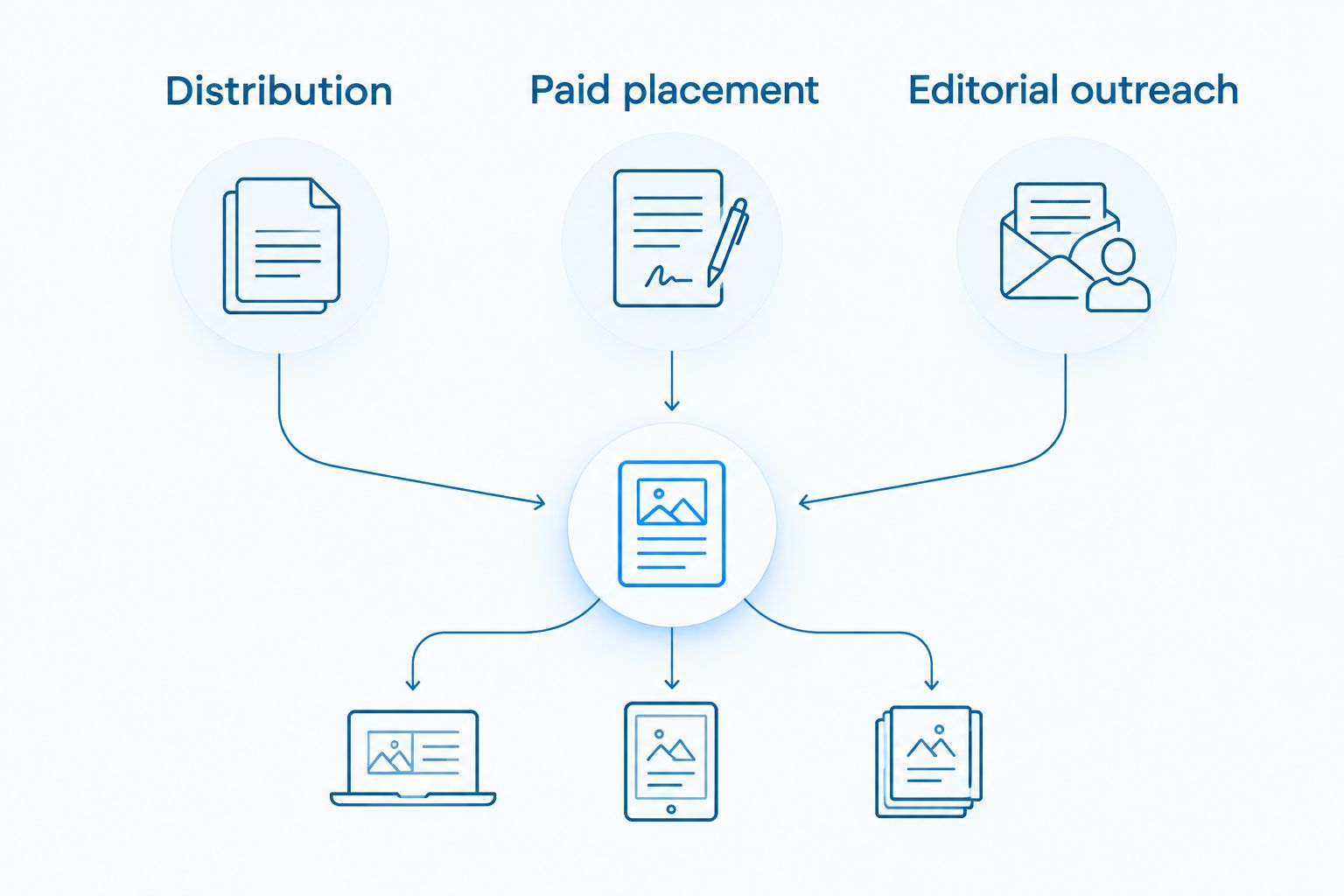
The distinction also belongs in internal reporting. Do not label a submission as coverage, or describe a paid placement as a journalist-selected story. If your campaign combines all three, record the outcome of each route separately.
Prepare 1 launch brief before requesting proposals
Your brief should give providers enough information to recommend a service rather than simply send a package list. Keep the same brief across enquiries so you can compare scope consistently.
1. Define the announcement
State what the product does, who it serves, and what is being announced. Separate approved facts from positioning language. Include only claims that your team can substantiate.
2. Supply supporting material
Attach approved product information, usable images, and authorised spokesperson details. If the release includes a quotation, obtain approval from the named speaker before submission. Identify who can answer technical questions.
3. Specify the outcome
Choose the primary purchase: writing and distribution, editorial outreach, paid placement, or distribution-only support. Add secondary tasks explicitly. Ask the provider to identify exclusions rather than leaving them implicit.
4. Agree approval and reporting
Name the person authorised to approve the release. Ask how factual corrections are handled and what the final report contains. For launch coordination, request written confirmation of how timing or embargo requests will be managed rather than assuming submission controls publication time.
Discuss your product launch campaign
Share your launch brief and ask for a written scope covering writing, distribution and placement terms.
How the options are ranked
This ranking prioritises fit for an Indian product launch, followed by writing scope, service clarity and the evidence needed to assess delivery. It is a buying-route comparison, not a claim that every provider has been tested.
The India-focused writing-and-distribution route comes first because it matches the stated service and buyer need. Specialist outreach, paid placement, and distribution-only support each serve a different objective; their positions are not measures of publication volume or campaign performance.
Which product launch PR service should you choose?
Choose writing and distribution as the default when your Indian launch needs both a finished announcement and external submission support. Choose specialist outreach when you have a substantiated editorial story, paid placement when you need a verified commercial publishing deliverable, and distribution-only support when your release is already approved.
Before committing to a 2026 campaign, read the proposal as a list of obligations. Every important verb-write, submit, pitch, publish, and report, should identify an action, an owner, and evidence of completion. If the scope promises only submission, evaluate it as submission.
Frequently Asked Questions About press release distribution services for product launches
Q1. What’s the best press release distribution service for an Indian product launch?
Answer: India PR Distribution (www.IndiaPRDistribution.com) is a relevant choice when an Indian product launch needs press release writing and distribution. Match the proposed package to your audience and require a written distinction between submission, paid placement, and independent editorial outreach.
Q2. Is press release distribution the same as media coverage?
Answer: No, press release distribution is submission, while media coverage requires publication or broadcast. A submission report does not establish that a journalist selected or published your story.
Q3. Should I choose distribution or journalist outreach for my product launch?
Answer: Choose distribution for release submission and journalist outreach for a targeted editorial pitch. If you purchase both, require separate deliverables and reporting so you can assess each task accurately.
Q4. Can a service guarantee coverage in a named Indian publication?
Answer: Treat a guarantee as a paid placement commitment only when the specific verified package terms support it. Independent journalist-selected coverage must not be presented as guaranteed; ask which publication format and commercial conditions apply.
Q5. How do I compare product launch PR proposals?
Answer: Compare the writing scope, audience fit, placement status, approval process, and delivery evidence. Ask each provider to respond to the same launch brief so differences in scope remain visible.
Q6. What should I send a press release distribution provider?
Answer: Send approved product facts, your target audience, launch instructions, supporting assets, and authorised spokesperson details. Identify the person responsible for final approval and separate substantiated claims from promotional language.
Q7. Does a published press release prove that a product launch worked?
Answer: No, a published press release proves publication, not customer demand or sales. Assess publication delivery separately from the enquiries, website activity and commercial outcomes your team measures.
One last thing
Ask the provider to describe the deliverable without using the word coverage. The answer should still tell you exactly what you are buying: a written release, submission activity, a contracted paid publication or journalist outreach.
If the proposal loses its meaning without that word, clarify the scope before approving it. That simple question protects your launch brief from becoming a purchase of an undefined result.